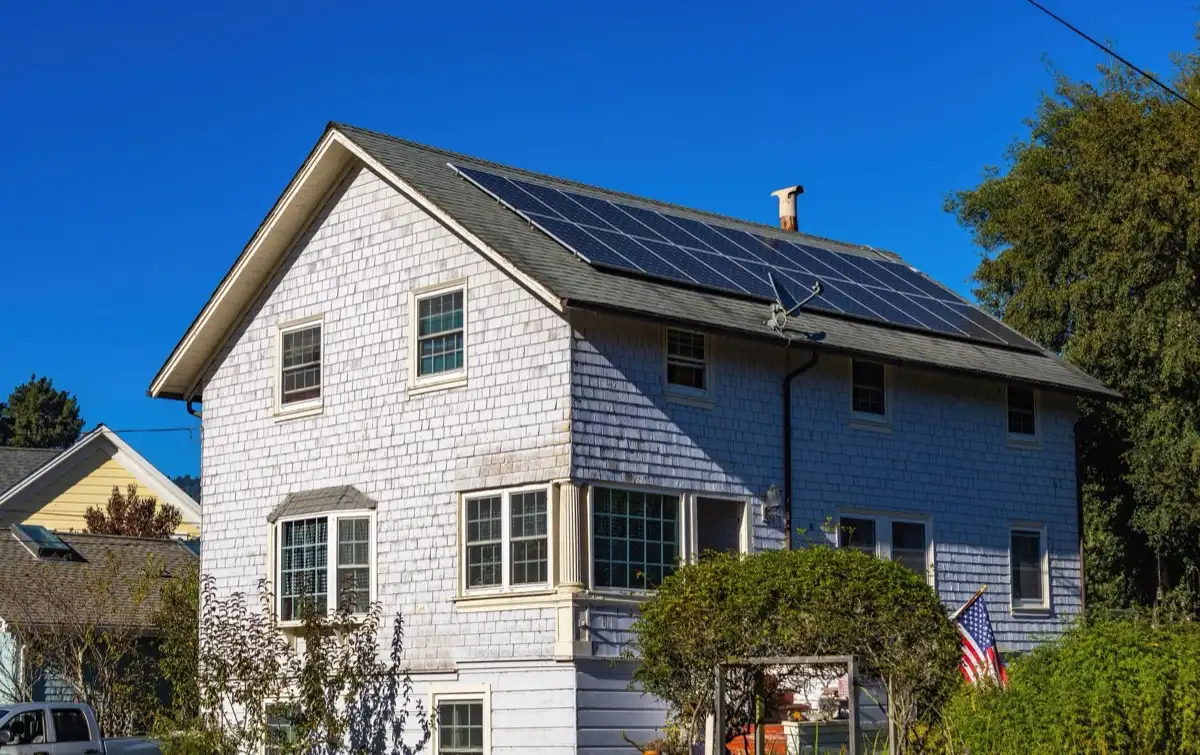
Whether your policy pays for a roof leak has almost nothing to do with the leak. It turns on what caused it. A roof broken by something is one thing; a roof that reached the end of its life and began letting water through is another, and only one of them is in the contract.
No adjuster doubts that you have water coming in; they can see the stain. They are deciding which of those two stories the roof supports.
What the policy actually says, and what it does not
Most homeowners policies in this country are built on the ISO special form, HO 00 03, and you can read one. The Maine Bureau of Insurance posts a filed copy of the 2011 edition; the Oklahoma Insurance Department posts an Oklahoma edition.
For the roof itself the operative sentence is short. "We insure against direct physical loss to property described in Coverages A and B." No list of storms, no peril menu. Everything, unless it is excluded.
Then comes the exclusion list, and the first item in its final group reads: "Wear and tear, marring, deterioration."
That pairing is the entire answer. The roof is insured against anything not on the list, and age is on the list by name.
One correction while we have the document open. The phrase everybody repeats, sudden and accidental, is not the standard for your roof. In that form it appears attached to smoke, to a burst heating system and to electrical current, all under personal property. It is serviceable shorthand for how the exclusions add up. It is not a sentence governing your dwelling, so do not go hunting for it.
Cause of loss, and why both stories are usually true
Cause of loss is the phrase that decides this, and it is worth saying out loud to an adjuster.
Storm on a dated day, roof intact before it: nothing excludes that, so it is covered. Roof at the end of its service life, no event behind it: excluded by name, and the argument is over before it starts.
The two cases mostly arrive together, because roofs do not fail on calm Tuesdays. A twenty-two-year-old roof leaks for the first time during a storm, because a storm is what finds the weakness that age built. The carrier reads that as a worn roof that finally lost, you read it as a storm, and the file is what settles it.
Your policy may not be an ISO form at all. Carriers file their own, states promulgate their own, and roof endorsements have been rewritten hard in the last decade. The shape above is the common one, not a promise about your paperwork.
The seepage clause people quote at you
If you have read anything else about roof leaks you have met this sentence: "constant or repeated seepage or leakage of water or the presence or condensation of humidity, moisture or vapor over a period of weeks, months or years."
It is real. It is also, in the current forms, aimed somewhere other than your roof.
In the Oklahoma edition the state posts, that wording is exclusion b.(5) inside peril 12, Accidental Discharge Or Overflow Of Water Or Steam — the plumbing peril. The same form then says a plumbing system "does not include a roof drain, gutter, downspout or similar fixtures or equipment." The 2011 ISO special form Maine posts does not carry the sentence in its dwelling perils at all.
So a long-running leak is not usually denied by the seepage clause. It is denied through three other doors, and they are worse:
- Evidence. Two years of water is a description of a condition, and conditions are what the wear exclusion is for.
- Prompt notice. The duties after a loss begin "Give prompt notice to us or our agent."
- Neglect, defined in the same form as "neglect of an 'insured' to use all reasonable means to save and preserve property at and after the time of a loss."
The practical version: waiting does not just cost you drywall. It converts an event into a condition, which is the conversion you cannot afford.
Your ceiling and your roof are two different decisions
This surprises people every time, and it is the most useful thing here after the wear exclusion.
The special form, immediately after the paragraphs containing the wear-and-tear exclusion, says: "any ensuing loss to property described in Coverages A and B not precluded by any other provision in this policy is covered." The exclusion for faulty, inadequate or defective maintenance carries the same carve-back in its own lead-in.
Which means a settlement that pays for the ceiling, the insulation and the paint while refusing the shingles is not an adjuster being difficult. It is that language working as written: the excluded cause stays excluded, the damage flowing from it may not be. The limits are real: carriers read ensuing loss differently, courts have disagreed for decades, and nobody should promise you an outcome. Ask for the provision by name and make them answer in writing.
Your furniture sits on a third footing again. Personal property in the HO-3 is named-peril, and the windstorm or hail peril says it "does not include loss to the property contained in a building caused by rain, snow, sleet, sand or dust unless the direct force of wind or hail damages the building causing an opening in a roof or wall and the rain ... enters through this opening." A rug under a wind-torn hole is covered. A rug under a perished pipe boot is a much longer conversation.
How to find a leak in your roof when coverage is the question
Tracing where water gets in is a separate job with its own method: how to find and fix a roof leak. What you collect for a coverage argument is different. Not a location. A date and a mechanism.
Get a first day. Every leak has one. A named date with weather behind it is the strongest single item in a claim file, and a shrug is the weakest.
Count slopes. Storm damage has a direction; weather comes from somewhere. Failures concentrated on the slope that faced the wind read as an event. The same failure appearing on all four slopes reads as a roof that ran out of years, because sunlight does not have a direction.
Ask whether the part failed or broke. A pipe boot with a clean ring crack around the pipe died of ultraviolet and twelve summers. A boot with a piece torn out of it, and the piece in the gutter, did not. A shingle creased across its face with the seal line still intact was lifted by wind. A shingle curled, cupped and showing bare mat is a calendar, not an event.
Date it from the attic. The same attic trip that finds the entry point, read for a different purpose. Rust rings around nail points take seasons to form. Clean bright wood at the edge of a wet patch says the opposite. Hard-edged tide marks on a rafter mean many wet-and-dry cycles rather than one storm. Photograph it before anyone tarps anything.
Then get a written roof inspection with slope-by-slope photographs. Building the rest of the file — soft metal, the storm record, reconciling scopes — is its own subject.
A denial is not free
Washington's Office of the Insurance Commissioner describes CLUE as generally holding up to seven years of personal auto and personal property claims history, and says an insurer "uses your claims history, or the history of claims at a specific property, to decide if it'll offer you coverage and how much you'll pay."
Read the second half of that sentence twice. The record attaches to the address, not only to you, and it is still sitting there when you sell the house.
The same page notes that LexisNexis advises insurers not to report it when you contact them simply to ask a question about coverage or your deductible. That distinction is worth using. Asking your agent how your roof is written is not a claim.
When filing is the wrong move
Find out what the repair costs before deciding whether it is a claim, which is the reverse of the order almost everybody uses. A large share of leak repairs land under a modern deductible and are therefore not claims at all — the arithmetic is in what it costs to fix a leak. So: diagnose, price, then decide.
The exception is interior damage. The boot is cheap and the ceiling under it is not, so a trivial roof failure with a soaked bedroom behind it can be a real claim when the roof work alone never would be.
The contract you signed while the claim was still open
People do this in the wrong order routinely: sign first, find out second. Whether the denial letter is any use to you at that point is a Oregon question, and in several states the answer is that it is not.
Oregon never wrote a roofing-and-insurance statute. There is no window to cancel after your insurer denies the claim, no required insurance-claim wording in the contract, and nothing in the contractor code stopping a roofer from dealing with your adjuster. Chapter 701 mentions insurance once and it is about the contractor carrying its own liability cover. The one contract rule that does apply here: residential work over two thousand dollars has to be in writing.
The deductible offer, on the one claim that runs on your credibility
A worn-versus-broken claim is decided partly on whether the file is believable, which makes the offer to make your deductible disappear worse here than anywhere else on the roof. It puts a number in front of your carrier that nobody intends to collect. Whether Oregon names the practice in a statute varies more than the industry lets on.
Nothing in Oregon law stops a roofer from eating your deductible. The rebate statute people turn up, ORS 746.045, bans rebating insurance premiums and is aimed at insurers and producers rather than contractors. That leaves general fraud law as the only backstop, so treat an offer to cover your deductible as a signal about the company rather than as something a regulator is going to act on.
Bottom line
The question is never whether you have a leak. It is whether the roof was broken or worn out, because the form insures against direct physical loss and then excludes wear and tear by name. Get a first day, count how many slopes failed, look at whether parts tore or perished, and photograph the attic before anybody touches the roof. Ask about ensuing loss for the ceiling separately. And price the repair before you file, because a denial you could have predicted still sits on the property for seven years.
Broken or worn out is the entire question, and photographs taken before anybody works on the roof are what decide it. Bend Roof Pros dates and documents leaks in Bend and Central Oregon, then does the roof leak repair, roof inspections and storm damage restoration that follow. Call (877) 728-1157 before you file, and we will tell you what caused it — including when the honest answer is age.
Ready for a free quote in Bend?
Bend Roof Pros — free estimate, clear scope, no pressure. Use the form on this page or jump to the homepage quote.
Related services in Bend
Bend Roof Pros money pages — go straight to the service you need.
- Roof Leak Repair →
Roughly half the winter calls we take in Bend are not leaks. They are condensation, and the daily temperature swing is what makes this town so good at producing them.
- Storm Damage Restoration →
Central Oregon storms do their damage two ways: hard dry wind coming off open juniper steppe, and heavy wet snow that arrives when a Pacific system finally makes it over the Cascade crest. Both of those land on roofs the daily cycle has already been working on for years.
- Roof Inspections →
We inspect Bend roofs early in the morning on purpose, and it is the one scheduling habit that most surprises people who have bought roofs somewhere else. It is not a gimmick.
- Roof Replacement →
The calendar decides more about a Bend roof replacement than the shingle brand does. Our tear-off window is set by the overnight low, not the afternoon high, and in Central Oregon those two numbers sit further apart than they do on the west side of the mountains.
- Hail Damage Roofing →
This page exists to argue you out of a purchase. Bend is not a hail market, and a knock on the door telling you otherwise deserves a hard look before you sign anything at all.
Frequently asked questions
Will home insurance cover a roof leak?
It depends entirely on what caused the leak, not on the leak. The standard special form insures the dwelling against direct physical loss and then excludes a list of causes, and the first item in the last group of that list is wear and tear, marring, deterioration.
So a roof broken by a storm is covered because nothing excludes it, and a roof that wore out is not covered because age is excluded by name. The adjuster is deciding which of those two things happened, and that is the only question being asked.
My roof is old and it started leaking after a storm. Will they pay?
That is the hard case and it is also the common one, because roofs mostly fail in weather rather than on a calm day. Both stories are partly true, so the file decides it.
What helps is evidence of an event rather than of a condition: damage concentrated on the slope that faced the wind, a shingle creased with its seal line intact, a torn boot with the missing piece in the gutter, a first day you can name.
What hurts is the same failure showing up on every slope, which is what a worn roof looks like.
If the roof is not covered, is the water damage inside my house covered?
Frequently yes, and it is a separate decision under separate language. The special form says that under the paragraphs containing the wear-and-tear exclusion, any ensuing loss to the dwelling not precluded by another provision is covered, and the same carve-back is attached to the faulty-maintenance exclusion.
So a settlement that pays for drywall, insulation and paint but refuses the shingles is not the adjuster being arbitrary. It is the ensuing loss wording doing exactly what it says. Carriers read it differently and so have courts, so ask for that line by name.
Is there a clause that excludes a long-running leak?
The sentence usually quoted at homeowners is real but is mostly aimed somewhere else. In the Oklahoma edition posted by that state's insurance department, the constant-or-repeated-seepage-over-weeks-months-or-years wording is an exclusion inside the accidental discharge peril, which is plumbing, and that same form says a plumbing system does not include a roof drain, gutter or downspout.
The 2011 ISO special form does not carry the sentence in its dwelling perils at all. Duration still hurts you, just through three other doors: it is evidence of wear, it collides with the duty to give prompt notice, and it collides with the neglect exclusion.
Does a denied claim still go on my record?
Yes. Washington's Office of the Insurance Commissioner describes the CLUE database as generally holding up to seven years of personal auto and personal property claims history, and says an insurer uses your claims history, or the history of claims at a specific property, to decide whether to offer coverage and what to charge. Read the second half of that twice.
The record attaches to the address as well as to you, and it is still there when you sell. The same page notes that simply calling to ask a question about coverage or your deductible is not supposed to be reported as a claim.
How do I know whether my leak is a claim at all?
Find out what the repair costs before you decide, which is the reverse of the order most people use. A large share of leak repairs land under a modern deductible, so they are repairs and never claims.
The exception worth watching for is interior damage: the boot is cheap, and the drywall, insulation and flooring underneath it are not, so a small roof failure with a big ceiling behind it can be a real claim while the roof work alone would not be.
Local context
How this applies in Bend, OR
Every article here is written from roofing work done in Bend and Central Oregon, so the numbers reflect local labour, permit and material costs rather than a national average. Your own job can land either side of them depending on access, the condition of what is already there, and the materials you pick — concealed floating clips slotted for daily panel travel, sealant selected by its published movement class, hand-sealed tabs set in dabs of asphalt roof cement.
The way to turn any of this into a real answer is to have someone look at your actual situation. The free estimate is free, itemized and written down, with no deposit and no obligation. Call (877) 728-1157 or start on the Bend Roof Pros homepage.
Areas Bend Roof Pros covers
Bend first, then the surrounding communities of Central Oregon. Each has its own page with local detail rather than a copy of this one:
- Redmond, OR — Deschutes County, population 33,274
- Sisters, OR — Deschutes County, population 3,064
- La Pine, OR — Deschutes County, population 2,512
- Sunriver, OR — Deschutes County, population 2,023
- Terrebonne, OR — Deschutes County, population 1,393
- Tumalo, OR — Deschutes County, population 558
Or jump to the full list of Bend services.
More from the Bend Roof Pros blog
- What Is a Soffit? The Board Under Your Bend, OR Eaves
Soffit is the underside of the overhang, fascia is the board on its edge. Why vented soffit is the intake half of a Bend, OR attic, and how both boards fail.
- What Is a Drip Edge? The Metal That Saves Your Bend, OR Fascia
Drip edge is the bent metal at the eaves and rakes that keeps runoff off your fascia. The profiles, the two details that decide whether it works, and the code in Bend, OR.
- What Are Seamless Gutters? Rolled on Your Bend, OR Driveway
Seamless gutter is roll-formed on site from a coil, which is why it is a contractor-only product. What the name buys, where the joints moved to, and what a cheap Bend, OR install looks like.
The Bend Roof Pros Team
roofing specialists serving Bend, OR
Written by the Bend Roof Pros team — insured roofing pros serving Bend, OR and the surrounding area.