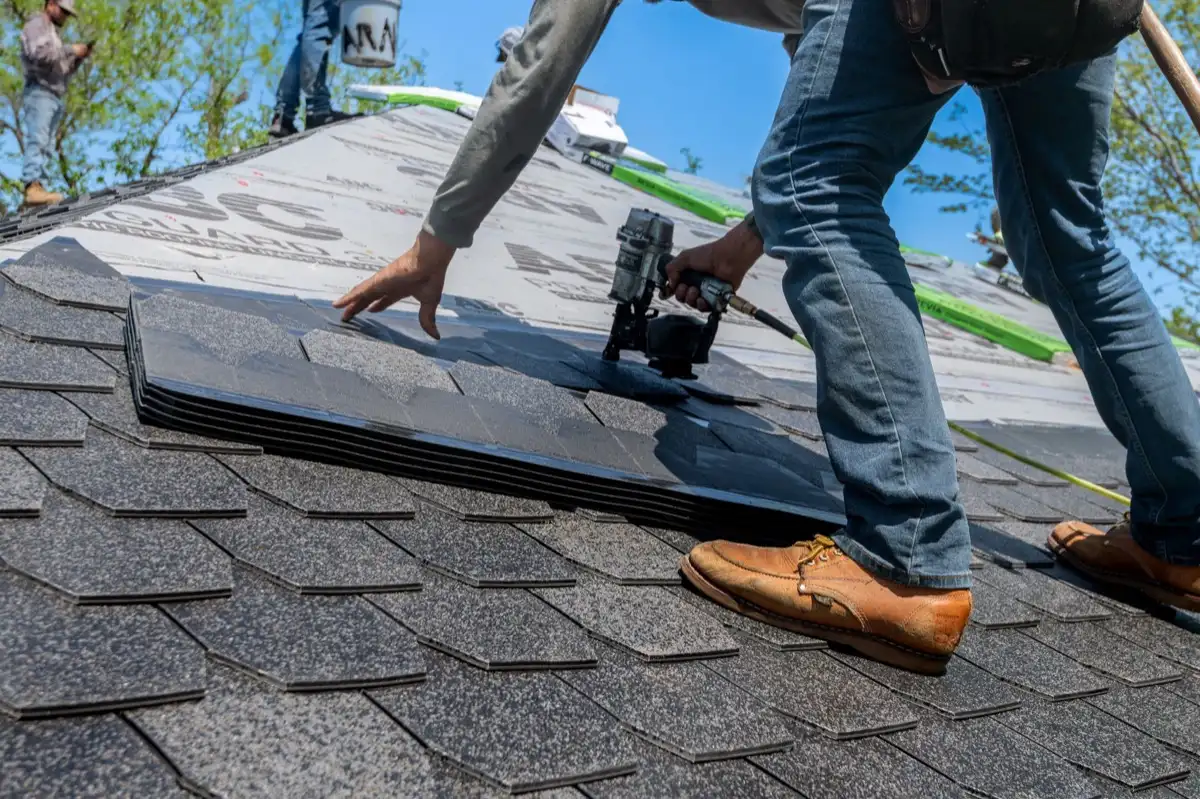
A hail inspection is a counting exercise, not a look. Whether your roof gets replaced is decided inside a chalked ten-by-ten square on each slope, by a count of what is found in it, measured against a number your carrier chose.
Almost everything homeowners get told about hail skips it, because a count is harder to sell than a picture.
The ten-by-ten test square
One hundred square feet — not a coincidence: a square is the roofing trade's unit of measure, what materials and labor are priced in. Haag Engineering's engineers built the method in the early 1960s, published it in 1975 and had it peer reviewed in 1999. It is what most adjusters trained on.
The order matters as much as the square. Haag's protocol starts at ground level — junction boxes, fences, gutters, downspouts, decks, the air-conditioner — to establish the size and direction of what fell, then the ridges and valleys where shingles are poorly supported and break first. The squares come last.
One per directional slope, because hail arrives from a direction and a leeward slope is a different sample. They go away from overhanging trees and the paths people walk, and extra ones get drawn where the roof genuinely differs: an old 9:12 main slope and a new 3:12 porch are two roofs.
Inside, every shingle is examined and hand-manipulated for creases, breaks, soft spots and bruises. The count is multiplied by the squares on that slope direction, which is how a hundred square feet becomes a roof — then a price. Haag's DURA formula, damaged units per square times unit cost times a repair-difficulty factor times actual slope area, is why the square exists at all. It produces a number, not a verdict.
What does hail damage to shingles look like when someone is counting it
A fracture in the mat, and what that is and is not is a subject of its own. Inside the square the question is narrower: three conditions get recorded as hail impact — bruises, meaning mat fractures; punctures; and displacement of granules sufficient to expose the bitumen underneath.
Two mechanics decide whether two inspectors agree.
Counting is per roofing unit, not per mark. Three bruises on one shingle is one damaged shingle. Someone reporting "thirty-one hits" without saying which they counted has reported nothing.
The soft spot is found by hand, not by eye. That is why every shingle in the square gets manipulated, and why a drone finds candidates but cannot finish the job.
Chalk is trade practice rather than protocol: marks get circled so they can be photographed, re-found and recounted, and so nothing is counted twice. It washes off; anything that does not has no business on a roof somebody may keep.
How many hits it takes, and why nobody can give you the number
There is no national threshold. Haag publishes the method and not a replacement number; its material stops at the observation that a repair-or-replace decision can be made once the extent of damage is known. Figures like eight or ten damaged units per square circulate everywhere, repeated as though they were a standard. They trace to neither Haag nor any published standard. They are carrier claim-handling guidelines, and they differ by carrier and by region.
So the count is measured against a private number. Not a scandal, just the shape of the thing — and it changes the questions.
Three are fair, all on the day: how many squares were run and where, what is being counted as a unit, and what threshold the file is worked to. Write the answers down. A slope that never got a square cannot have been counted, and slopes get missed — the back of the house and the detached garage most of all.
Hail damage asphalt shingles: what moves the count
The method was built around asphalt composition shingles and the criteria are theirs — on tile, slate, wood or a membrane the square still gets drawn, but what qualifies as damage inside it changes entirely. On asphalt, three things move the count independent of the storm.
Age and mat type. Older, more brittle shingles fracture at smaller stone sizes, and Haag's ice-impact thresholds differ between three-tab and laminated products.
Support underneath. Ridges, hips, rakes and eaves have the least backing and break first, which is how a roof with a clean field still fails at its edges. An old plank deck flexes more than modern sheathing.
Impact rating, if the roof has one. UL 2218 grades coverings Class 1 to 4 by dropping steel balls twice on the same spot, a two-inch ball for Class 4; FM 4473 runs a comparable scale with launched ice balls, aimed at rigid coverings. Both are laboratory results against a projectile, not a promise about a storm. The practical argument for Class 4 at replacement is the premium discount carriers give it.
Hail damage roof pictures: what a photograph can prove
Less than you would like. The fracture propagates from the underside upward, so a photograph of the top of a shingle records a mark, not the damage. Pictures are evidence of what was found and where, not a diagnosis at a distance. A set that survives a second reading contains:
- One wide shot per slope, with something in frame identifying which slope it is
- The chalked square, so the sample area is visible and re-findable
- Each counted mark close up, with a tape or a coin for scale
- At least one lifted shingle showing the underside — the only image that settles anything
- The ground-level collateral — dented gutters, vent caps, condenser fins — at the same scale, uncropped and with timestamps intact
Take them before anyone walks the roof: foot traffic on warm asphalt leaves its own marks, and they get argued about later.
A warning about the pictures you find by searching: galleries select for the unmistakable, because those photograph well. Real damage is often invisible in a photograph of a real roof, so a gallery talks people out of good claims about as often as into bad ones.
Two inspections, two purposes, one morning
Both are legitimate, and they are not the same product.
| Contractor's inspection | Adjuster's inspection | |
|---|---|---|
| Paid by | The contractor, from work it hopes to win | Your carrier |
| Question answered | What is damaged, and what would it cost | Does this policy pay, and how much |
| Output | A scope and a price | A scope sheet and a settlement |
| Standing | None until the two are reconciled | Decides the claim |
Say the quiet part: a free inspection offered door to door after a storm is a sales call. Not a slur — it is how storm work has always been sold, and plenty of those crews are competent. It stops being fine when it is offered as a neutral second opinion. What a paid report contains is in roof inspection cost.
On the adjuster's day, be there. You need not climb anything — stand at the ladder, ask the three questions above, and ask for photographs rather than a verdict. Bring your own documented inspection, pre-storm pictures and the storm date; building that file is the half you control.
Your contractor up there at the same time is useful: the two scopes get compared while everyone is still on the roof. What it may not do is work the claim for you — several states forbid exactly that.
What credential a Oregon roofer can actually show you
The week after a hailstorm, the number of people offering to inspect your roof goes up sharply, and the credential they hold up varies by state more than anything else here.
Oregon is unusual on the threshold question because there isn't one. ORS 701.021 requires a Construction Contractors Board license to bid or perform any construction work at all, at any price - the five-hundred-dollar exemption repeated everywhere is really a thousand-dollar carve-out for casual work that evaporates the moment a company advertises. Roofing sits under a residential specialty endorsement, bonded at twenty thousand dollars since 2024. Unlicensed, a contractor can neither lien nor sue.
Signing before the claim is decided, in Oregon
Hail contracts get signed in driveways, often within days and often before a single shingle has been lifted. Whether you can get back out of one, and when the clock starts, is set by statute.
Oregon never wrote a roofing-and-insurance statute. There is no window to cancel after your insurer denies the claim, no required insurance-claim wording in the contract, and nothing in the contractor code stopping a roofer from dealing with your adjuster. Chapter 701 mentions insurance once and it is about the contractor carrying its own liability cover. The one contract rule that does apply here: residential work over two thousand dollars has to be in writing.
The deductible offer, and where Oregon puts it
It surfaces during the inspection, phrased as helpfulness: we will work with your deductible. Before deciding how that sounds, read what it is where you live.
Nothing in Oregon law stops a roofer from eating your deductible. The rebate statute people turn up, ORS 746.045, bans rebating insurance premiums and is aimed at insurers and producers rather than contractors. That leaves general fraud law as the only backstop, so treat an offer to cover your deductible as a signal about the company rather than as something a regulator is going to act on.
Hail damage on a roof: when to replace
The question is never whether a mark exists. It is how many, on how many slopes, and what condition the rest of the roof is in.
Repair holds up when the count sits on one slope or on the unsupported edges, the shingles still lift without cracking, and the product is still available in a livable color.
Replacement is the honest answer when several slopes count over the threshold, when the shingles are brittle enough that repairing them breaks more than it fixes — a real limit, not a sales line — or when the product is discontinued and the repair leaves a band across the front of the house. If the roof was near the end of its service life anyway, the storm did not cost you a roof; it set the date.
There is a third answer people are rarely offered: a real count, under the threshold, documented and filed. A bruised mat is a shortened life, not an open hole, so nothing leaks to force your hand — which is why the decision drifts until the policy's notice window has closed. That report becomes the baseline for the next storm.
Bottom line
Ten by ten, one per directional slope, every shingle inside it touched. The count is per shingle, not per mark, and the threshold it is measured against is your carrier's rather than any national standard — so ask what it is. Photograph the square, the scale and the underside of a lifted shingle before anyone walks the roof. Then make the call on the count, not on a picture gallery or a driveway opinion.
Bend Roof Pros runs documented roof inspections, storm damage restoration and roof replacement across Bend and Central Oregon. Call (877) 728-1157 for a slope-by-slope report with the test squares marked and photographed — including the times the count comes back under the line and we say so.
Ready for a free quote in Bend?
Bend Roof Pros — free estimate, clear scope, no pressure. Use the form on this page or jump to the homepage quote.
Related services in Bend
Bend Roof Pros money pages — go straight to the service you need.
- Roof Replacement →
The calendar decides more about a Bend roof replacement than the shingle brand does. Our tear-off window is set by the overnight low, not the afternoon high, and in Central Oregon those two numbers sit further apart than they do on the west side of the mountains.
- Storm Damage Restoration →
Central Oregon storms do their damage two ways: hard dry wind coming off open juniper steppe, and heavy wet snow that arrives when a Pacific system finally makes it over the Cascade crest. Both of those land on roofs the daily cycle has already been working on for years.
- Roof Inspections →
We inspect Bend roofs early in the morning on purpose, and it is the one scheduling habit that most surprises people who have bought roofs somewhere else. It is not a gimmick.
- Roof Leak Repair →
Roughly half the winter calls we take in Bend are not leaks. They are condensation, and the daily temperature swing is what makes this town so good at producing them.
- Hail Damage Roofing →
This page exists to argue you out of a purchase. Bend is not a hail market, and a knock on the door telling you otherwise deserves a hard look before you sign anything at all.
Frequently asked questions
What happens during a hail damage roof inspection?
In the protocol most adjusters were trained against, the roof is inspected last.
The inspector starts at ground level on soft metal and painted surfaces — junction boxes, fences, gutters, downspouts, decks, the air conditioner — to establish the size and direction of the hailfall, then looks at ridges and valleys where shingles are poorly supported and break first, and only then draws a ten-by-ten-foot test square on each directional slope and hand-checks every shingle inside it.
Anyone who went straight up the ladder skipped the part that gives the roof its context.
What is a test square on a roof?
A ten-by-ten-foot area, one hundred square feet, which is also the roofing trade's unit of measure — one square. Haag engineers developed the method in the early 1960s; it appeared in print in 1975 and was peer reviewed in a 1999 technical paper.
The inspector examines and hand-manipulates every shingle inside it, counts how many are damaged, and multiplies that count by the number of squares on that slope direction to estimate the whole roof. One square per directional slope is the minimum, and extra squares are drawn where conditions differ, such as an old steep main roof against a newer low-slope porch.
How many hail hits does it take to replace a roof?
There is no national number, and anyone who quotes you one as a standard is quoting an insurer's internal guideline or a competitor's. Haag publishes the counting method and does not publish a replacement threshold; its own material stops at saying the repair-or-replace decision can be made once the extent of damage is known.
Thresholds per hundred square feet are set by carriers and vary by carrier and by region. The fair question to ask on the day is what threshold the file is being worked to and how many squares were run.
Can you identify hail damage from pictures?
Only partly, and that is the honest answer nobody selling a roof gives. The fracture that defines hail damage starts on the underside of the shingle, so a photograph of the top of a shingle cannot show it. Photographs are for recording what was found, where, on which slope and at what scale — not for diagnosis at a distance. Image galleries also select for the obvious cases, which makes real roofs look innocent by comparison.
Should I be there when the adjuster inspects my roof?
Yes, and it costs you nothing but a morning. You do not have to climb anything. Be at the ladder, ask which slopes got a test square and how many, ask for the photographs, and write down the answers. An adjuster working a documented file behaves differently from one working an empty one, and a homeowner who asks specific questions is the cheapest documentation there is.
When does hail damage mean replacing the roof instead of repairing it?
When the counted damage crosses the carrier's threshold on multiple slopes, when the shingles are brittle enough that repairing them creates more broken shingles than it fixes, or when the product is discontinued and a repair would leave a visible band on the front of the house.
A bruised mat is a shortened life rather than an open hole, so nothing forces the timing — which is exactly why the decision gets deferred until the notice window in the policy has quietly closed.
Local context
How this applies in Bend, OR
Every article here is written from roofing work done in Bend and Central Oregon, so the numbers reflect local labour, permit and material costs rather than a national average. Your own job can land either side of them depending on access, the condition of what is already there, and the materials you pick — concealed floating clips slotted for daily panel travel, sealant selected by its published movement class, hand-sealed tabs set in dabs of asphalt roof cement.
The way to turn any of this into a real answer is to have someone look at your actual situation. The free estimate is free, itemized and written down, with no deposit and no obligation. Call (877) 728-1157 or start on the Bend Roof Pros homepage.
Areas Bend Roof Pros covers
Bend first, then the surrounding communities of Central Oregon. Each has its own page with local detail rather than a copy of this one:
- Redmond, OR — Deschutes County, population 33,274
- Sisters, OR — Deschutes County, population 3,064
- La Pine, OR — Deschutes County, population 2,512
- Sunriver, OR — Deschutes County, population 2,023
- Terrebonne, OR — Deschutes County, population 1,393
- Tumalo, OR — Deschutes County, population 558
Or jump to the full list of Bend services.
More from the Bend Roof Pros blog
- Hail Damage on a Foam Roof in Bend, OR: What Breaks Under the Coating
On a foam or single-ply roof the hail damage is usually under the surface, and the assessment is a cut sample rather than a look. How SPF, TPO and EPDM actually fail in Bend, OR.
- Flashing on a Roof in Bend, OR: Where Roofs Actually Leak
Flashing is the metal at every joint on your roof, it is invisible from the ground, and it is what fails. What the pieces do in Bend, OR, and how to tell if yours were done right.
- Flashing Chimney Repair Cost in Bend, OR: What Sets the Number
A chimney needs four flashing pieces working as one, on masonry that has its own condition. What drives the price in Bend, OR, and why no range fits.
The Bend Roof Pros Team
roofing specialists serving Bend, OR
Written by the Bend Roof Pros team — insured roofing pros serving Bend, OR and the surrounding area.