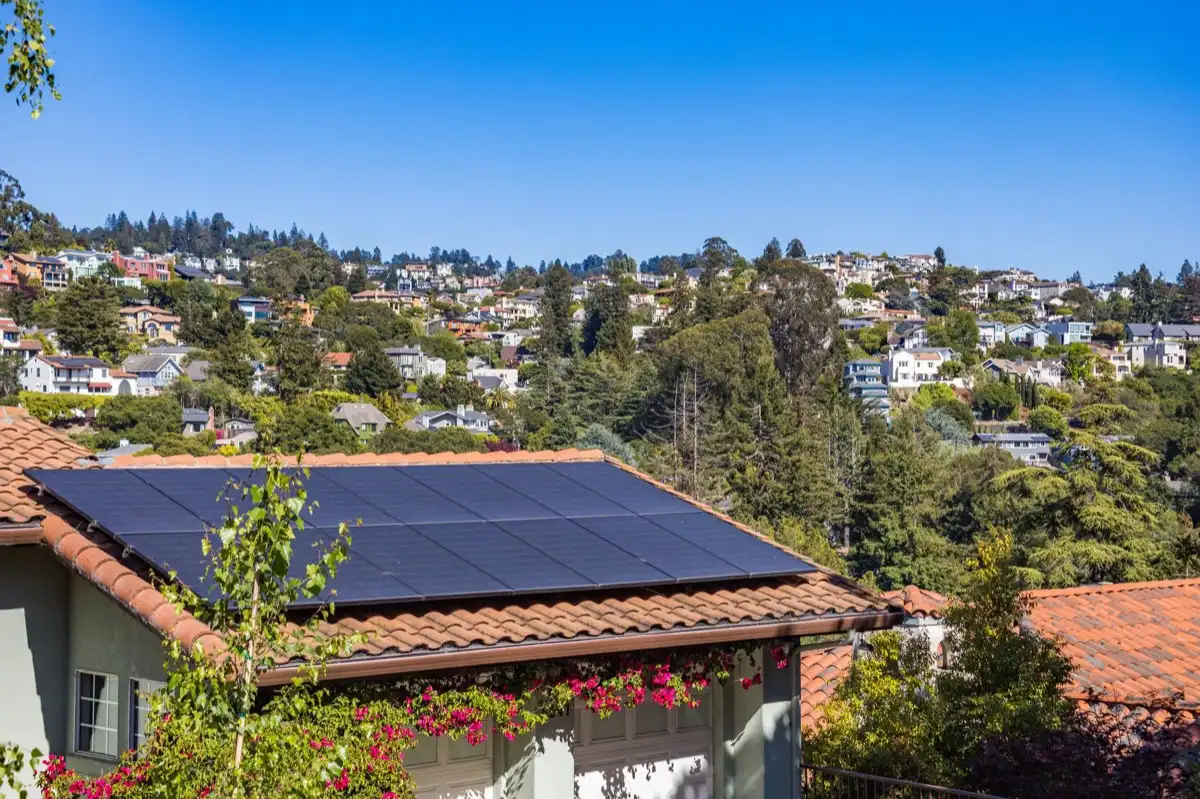
A hip sheds water away from itself. A valley concentrates it. From the driveway they look like one line bent opposite ways, which is exactly what they are.
That asymmetry explains the failure record. Hips mostly do not leak. Valleys do, constantly — and the ones that do the most damage have no fall in them at all.
Hip and valley: the same joint, opposite jobs
A hip is the convex line where two planes turn away from each other, so water landing near it runs off down both slopes. A valley is the concave line where they turn toward each other, so both slopes deliver their runoff into one channel — any foot of which carries a multiple of what a foot of open field sees. That makes a hip a covering problem, cap shingles and wind lifting the ends, and a valley a drainage problem. Drainage problems arrive as ceiling stains.
The wind trade-off is worth knowing. A hip roof has no gable ends, so all four planes brace each other and it takes high wind better than a gable of the same size — Florida's uniform mitigation verification form, OIR-B1-1802, pays a roof-shape credit for a full hip, defined as no other roof shape over ten percent of the perimeter. What it costs is complexity, a driver in roof replacement cost.
Roof valley types: three ways to close one joint
Every valley has a lining under it; what changes is what sits on top. Open, where metal stays exposed and water runs on it. Closed-cut and woven, where the shingles are the valley. Plus the California valley, which exists to skip the cutting.
Closed-cut is the residential default: one plane's shingles run through the valley and a foot up the far slope, the other plane's are cut in a straight line an inch or two off the centerline, and that edge is trimmed and bedded. Done well it works. Its problem is not performance but opacity — the lining sits under two layers of shingle and nobody sees it again.
Woven interlaces courses from both planes alternately, so nothing gets cut. On old 3-tab it was fine. On modern laminate it is the worst option on the roof: laminate is thick and stiff, will not lie flat into a trough, and gives you a bridge with a void under it. Then somebody walks the valley and cracks the shingle. IKO notes it can void a warranty.
Open roof valley: the water runs on metal, not on asphalt
An open valley is metal laid over the lining and left exposed, shingles cut back both sides. The most durable of the three, and the reasoning is not complicated: water and ice slide on sheet metal faster than on the sawn edges of asphalt, debris clears instead of catching, and nothing abrades granules at the point of highest flow.
What separates a good one from a bad one, all trade practice:
- A center crease or rib, stopping cross-wash: runoff from the steeper plane shooting across and up under the other plane's shingles. And a channel that widens toward the eave, so a jam of pine needles at the top does not dam the run.
- No fasteners in the channel — the metal is held at its edges or with clips. A nail through the middle of a valley is a hole at the wettest point on the roof.
- One metal, not two. Aluminum downstream of copper corrodes galvanically, fastest in a wet channel.
The honest objection is appearance. An open valley is a metal stripe up the roof and plenty of people do not want one — a fair reason to pick closed-cut. "It lasts the same" is not.
California roof valley: the fast one, and where it runs out
A California valley — also called a Long Island or New Jersey valley — is a shortcut on the open valley. Rather than cutting the field shingles back along a chalk line, a run of shingles is laid vertically up the valley, butt edge to the center, and the field courses land against it. Nothing gets cut, which is the whole reason it exists.
It is not automatically wrong. IKO calls it adequate on steeper slopes, roughly 6:12 and up, where water moves fast and downhill, and worse as the slope drops: slower water travels laterally and works under the edge of that vertical shingle instead of past it. Some jurisdictions prohibit it and some manufacturers restrict it — one of the few valley questions where the local answer genuinely differs from the general one.
Roof dead valley: the one that actually fails
A dead valley is a valley with little or no fall. It arrives three ways: the valley dies into a wall instead of running out to an eave; a dormer or later addition was framed on top of an existing plane, leaving a pocket behind it; or two already low-slope planes intersect and the line between them is nearly flat.
Everything a valley does right, it does because it has somewhere to go. Take the fall away and the geometry inverts: water stands, debris packs into the corner and stays wet, snow sits longest. And the material in that puddle is asphalt shingle, which is a water-shedding product — it works by handing water to the piece below it — not a waterproofing membrane. Shingles are not rated to sit in standing water, and a dead valley is standing water by definition.
So the fix is a different material, not better shingle work:
- A metal pan, soldered or seamed, carried well up both adjoining planes and any wall it dies into. McElroy Metal is explicit that it must run high enough to allow for water washing upward under wind-driven rain.
- Or a fully adhered membrane — self-adhering modified bitumen, or a single-ply — lapped under the shingles above and behind the counter-flashing.
- Often a cricket underneath, manufacturing the fall the framing never gave it. Splitting the water two ways is the only permanent answer to a pocket with no downhill.
One signal for how seriously the trade takes this: several metal panel manufacturers exclude dead valleys from their weathertightness warranties, or cover them only on stated conditions. A manufacturer carving out one detail by name is telling you where the claims come from. In the field, meanwhile, a dead valley gets sealed two or three times before anybody rebuilds it, because caulk is cheap and looks like a repair. What the delay adds is in the cost of fixing a roof leak.
What the code actually requires in a valley
Valley linings for asphalt shingles are IRC R905.2.8.2, "Valleys" — the same number in 2018, 2021 and 2024. Checked against a licensed 2021 printout and the 2018 Seattle Residential Code reprint, since codes.iccsafe.org serves an empty page.
The mandatory part is one sentence: linings shall go on per the manufacturer's instructions, before the shingles. What follows opens "valley linings of the following types shall be permitted" — a menu, not a specification:
- Open valley, metal. Not less than 24 inches wide, in one of the corrosion-resistant metals of Table R905.2.8.2 — aluminum at 0.024 inch, 26-gauge galvanized, 16-ounce copper.
- Open valley, roll roofing. Two plies of mineral-surfaced roll roofing, an 18-inch layer under a 36-inch.
- Closed valley. One ply of smooth roll roofing at least 36 inches wide, or either option above. Self-adhering polymer-modified bitumen — ice-and-water membrane — is permitted in lieu of the lining, not on top of it. The 2024 edition puts a 36-inch width on that sentence; 2018 and 2021 do not.
Same finding as a sister post reached on sidewall flashing: the code permits several, and trade copy asserts one. Nobody is required to put metal in your valley, and the ice barrier the IRC does require, R905.1.2, is an eaves rule, not a valley rule. What binds a detail is the manufacturer's-instructions clause plus your jurisdiction's amendments.
Dead valleys are not in the code at all — the term appears nowhere in Chapter 9, so anyone quoting you a dead-valley section is inventing it. What bites instead is R905.2.2: asphalt shingles only at 2:12 and above, double underlayment from 2:12 to 4:12. A dead valley is usually under 2:12, so the argument is not that the shingles went on wrong. It is that they were never permitted there.
Who Oregon lets take money for a valley
A valley re-line is small enough to fall under whatever threshold a state wrote with whole re-roofs in mind, and the rules differ in kind, including states that set no bar at all.
Oregon is unusual on the threshold question because there isn't one. ORS 701.021 requires a Construction Contractors Board license to bid or perform any construction work at all, at any price - the five-hundred-dollar exemption repeated everywhere is really a thousand-dollar carve-out for casual work that evaporates the moment a company advertises. Roofing sits under a residential specialty endorsement, bonded at twenty thousand dollars since 2024. Unlicensed, a contractor can neither lien nor sue.
Reading your own valleys from the ground
Binoculars from the lawn settle most of it:
- A metal stripe — open valley. Check the center crease for rust, pinholes or a dulled line where the coating abraded off.
- Unbroken shingles, one straight cut line — closed-cut; nothing to see, which is the point. Rippling across the trough means woven, worth noting on a laminate roof.
- A vertical seam, no metal — California valley. Fine on a steep slope, a question on a shallow one.
- A valley ending at a wall rather than a gutter — dead valley. Confirm a day after rain: still wet, or holding a debris line or dark stain while everything else dried.
Past that, ask for a written roof inspection that photographs the valley from above and from the attic side. Nobody settles an argument about a closed-cut valley from the driveway, and a verbal all-clear leaves you nothing to hold anybody to later. The metal at the head of a valley belongs to the wider family in flashing on a roof.
Bottom line
Hips are a covering detail and they mostly behave. Valleys take the concentrated runoff of two planes, and they are where the roof gets decided. Ask which valley type is being quoted and get it in writing — open, closed-cut, woven or California is a choice, not a default. And if a valley dies into a wall, treat it separately and in a different material. No shingle detail has ever fixed one.
Bend Roof Pros does valley and dead-valley rebuilds, roof leak repair, roof inspections and roof replacement across Bend and Central Oregon. Call (877) 728-1157 and we will photograph every valley before anybody quotes.
Ready for a free quote in Bend?
Bend Roof Pros — free estimate, clear scope, no pressure. Use the form on this page or jump to the homepage quote.
Related services in Bend
Bend Roof Pros money pages — go straight to the service you need.
- Roof Replacement →
The calendar decides more about a Bend roof replacement than the shingle brand does. Our tear-off window is set by the overnight low, not the afternoon high, and in Central Oregon those two numbers sit further apart than they do on the west side of the mountains.
- Roof Leak Repair →
Roughly half the winter calls we take in Bend are not leaks. They are condensation, and the daily temperature swing is what makes this town so good at producing them.
- Roof Inspections →
We inspect Bend roofs early in the morning on purpose, and it is the one scheduling habit that most surprises people who have bought roofs somewhere else. It is not a gimmick.
- Storm Damage Restoration →
Central Oregon storms do their damage two ways: hard dry wind coming off open juniper steppe, and heavy wet snow that arrives when a Pacific system finally makes it over the Cascade crest. Both of those land on roofs the daily cycle has already been working on for years.
- Hail Damage Roofing →
This page exists to argue you out of a purchase. Bend is not a hail market, and a knock on the door telling you otherwise deserves a hard look before you sign anything at all.
Frequently asked questions
What is the difference between a hip and a valley on a roof?
They are the same joint bent the opposite way. A hip is the outward, convex line where two roof planes turn away from each other - water landing near it runs away from it, down both slopes.
A valley is the inward, concave line where two planes turn toward each other, so both slopes hand their runoff to that one line. That single difference explains almost everything about how the two behave. A hip is a covering problem: cap shingles, fasteners, wind lifting the ends.
A valley is a drainage problem, and drainage problems are the ones that end up on a ceiling.
What are the types of roof valley?
Three, plus one shortcut. Open, where a metal lining stays exposed and water runs on the metal. Closed-cut, where one plane's shingles run through the valley and the other plane's are cut back near the centerline. Woven, where courses from both planes are interlaced across the trough.
The shortcut is the California or Long Island valley, where a shingle is run vertically up the valley line so nothing has to be cut. They are not equivalent, and the choice is usually made by whoever is holding the knife rather than by anybody who asked you.
Is an open or closed valley better?
Open, on durability, and it is not especially close - water runs on metal instead of on the cut edges of asphalt, debris and ice clear faster, and when it fails you can see that it has.
The objection to it is appearance: an open valley is a visible metal stripe up the roof, and a lot of homeowners simply do not want one. Closed-cut is the common residential default, looks like an uninterrupted shingle field, and hides its own condition completely.
Woven is the one to argue about, because on modern laminate shingles it is the worst of the three.
What is a dead valley on a roof?
A valley with little or no fall - most often where a valley dies into a wall instead of running out to an eave, where a dormer or an added roof was framed on top of an existing slope, or where two already-low-slope planes intersect. A normal valley works because it has somewhere to go.
A dead valley does not, so water stands in it, debris packs into the corner, and snow sits there longest. It is the single most reliable place to find a leak on a roof that is otherwise fine.
Can a dead valley be fixed without replacing the roof?
Usually yes, and it should be, but not with shingles and not with sealant.
The repair is to line the area with something that holds standing water rather than sheds it - a soldered or seamed metal pan, or a fully adhered membrane - carried well up both adjoining planes and up any wall, with the shingles and the counter-flashing lapped over the top of it.
Often a cricket or saddle is built underneath to create fall where the framing gave it none. What it is not is a bead of caulk, which is what the first two attempts usually are.
Do I need metal in my roof valley?
For asphalt shingles the residential code does not make metal the only answer. It sets out the permitted valley linings and lists alternatives, and separately your shingle manufacturer's instructions are enforceable through the code, so a valley built the way the wrapper says is compliant even without exposed metal.
Where you should push for metal is not compliance, it is service life: an open metal valley outlasts a closed one on the same roof, and a dead valley needs metal or membrane because shingles are not rated to sit in water.
Local context
How this applies in Bend, OR
Every article here is written from roofing work done in Bend and Central Oregon, so the numbers reflect local labour, permit and material costs rather than a national average. Your own job can land either side of them depending on access, the condition of what is already there, and the materials you pick — concealed floating clips slotted for daily panel travel, sealant selected by its published movement class, hand-sealed tabs set in dabs of asphalt roof cement.
The way to turn any of this into a real answer is to have someone look at your actual situation. The free estimate is free, itemized and written down, with no deposit and no obligation. Call (877) 728-1157 or start on the Bend Roof Pros homepage.
Areas Bend Roof Pros covers
Bend first, then the surrounding communities of Central Oregon. Each has its own page with local detail rather than a copy of this one:
- Redmond, OR — Deschutes County, population 33,274
- Sisters, OR — Deschutes County, population 3,064
- La Pine, OR — Deschutes County, population 2,512
- Sunriver, OR — Deschutes County, population 2,023
- Terrebonne, OR — Deschutes County, population 1,393
- Tumalo, OR — Deschutes County, population 558
Or jump to the full list of Bend services.
More from the Bend Roof Pros blog
- Roof Decking Types in Bend, OR: Plywood, OSB, Boards and Span Ratings
Plywood, OSB, plank and spaced sheathing compared for Bend, OR roofs — what the span rating stamp means, what sets minimum thickness, and how the decking change order should be priced.
- Roof Damage From a Storm in Bend, OR: How Wind Actually Breaks a Roof
Wind damage is a broken seal and a creased tab, not a dent, and a failed shingle can look perfect from the ground. How wind losses are read in Bend, OR — and why the honest answer is often a repair.
- Moss on a Roof in Bend, OR: Three Organisms, Three Different Answers
Moss, black algae and lichen look like one problem and are not. What each one actually does to asphalt shingles, why it grows where it does, and when to act in Bend, OR.
The Bend Roof Pros Team
roofing specialists serving Bend, OR
Written by the Bend Roof Pros team — insured roofing pros serving Bend, OR and the surrounding area.