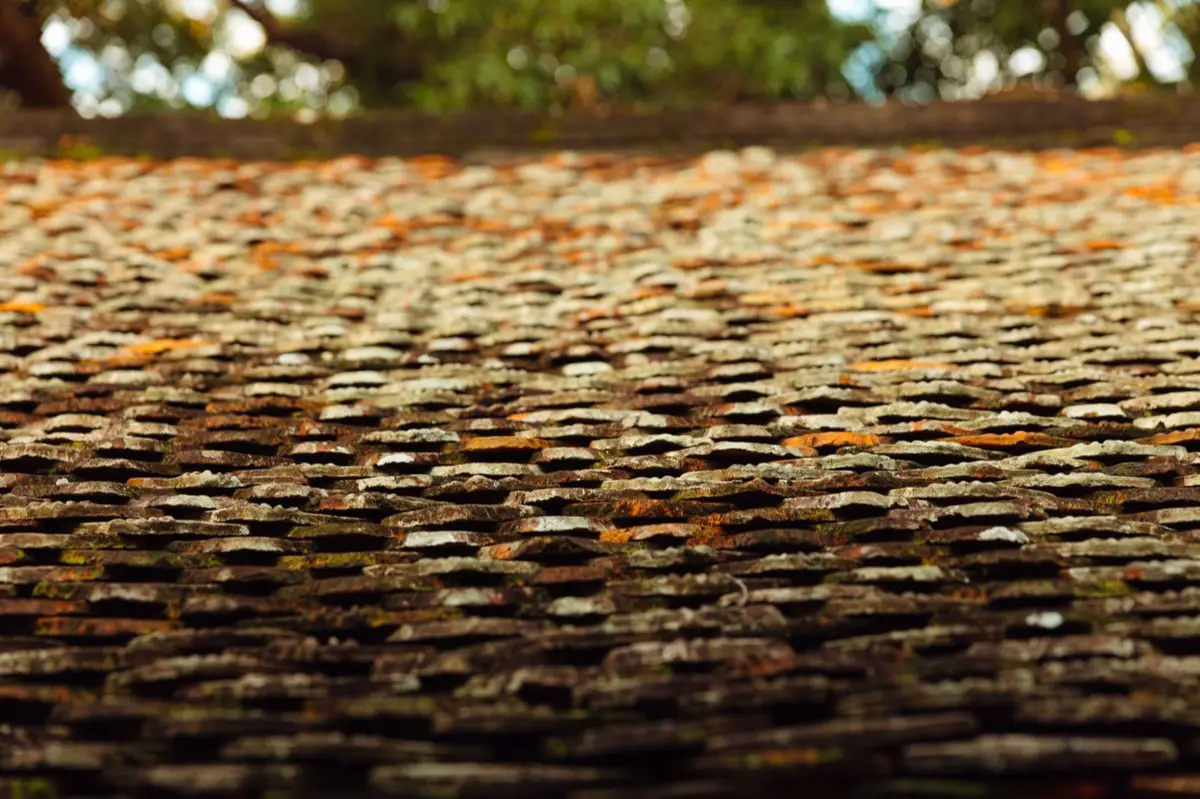
Moss on an asphalt roof is a slow problem, and the answer sold hardest against it is a fast one that ends the roof.
Source before argument. The Asphalt Roofing Manufacturers Association — the trade body of the companies that make the shingles — puts it in capitals in Algae Discoloration of Roofs, revised June 2024: "DO NOT use a power washer or any type of brush or broom to clean algae from the roof surface." High-pressure systems, it adds, "are likely to damage asphalt roofing and should not be used to remove algae or for any other purpose."
Most companies advertising roof cleaning sell what that sentence prohibits.
What a pressure washer does to a shingle
Granules are the wearing surface that takes the ultraviolet light so the asphalt underneath does not, and the shingle has no second one. ARMA names the mechanism — "this friction may loosen and remove granules" — and CertainTeed says the same of a power washer, whose "high powered spray can easily dislodge the roofing granules that protect your roof system from UV rays and water intrusion."
Moss is worse than algae here. Algae is a film; moss is a plant gripping the granule layer with rhizoids, sitting in the laps where water sits, and it does not release cleanly — tear it off and the granules go with it. ARMA supplies the other half: moss "can cause the leading edges of the shingles to lift or curl, which increases the risk of shingle blow-off during wind events." The roof is compromised before anyone points a wand at it.
What the shingle warranties actually say about washing
"It voids your warranty" is on every roof-cleaning page, and it is not what the documents say. Owens Corning's standard shingle warranty excludes damage from alterations made after the shingles are applied, and among the alterations it names is "the application of cleaning solutions." The clause runs longer than that and its real target is coatings, so it is quoted whole in shingles roof coating. What counts here is what is present and what is absent: cleaning solutions is excluded; power washing appears in neither version we could open. GAF's warranty does not mention washing at all.
What both exclude, plainly, is being on the roof. Owens Corning's not-covered list opens with "foot traffic on your roof"; GAF's excludes "impact of traffic on the roof or foreign objects."
So the honest version is less dramatic and more useful. No manufacturer needs an anti-pressure-washing clause: these warranties cover inherent manufacturing defects and little else, and every roof cleaning, the careful one included, sits outside them. Do it correctly to protect the roof, not the warranty.
Roof cleaning and moss removal: the method that looks like nothing happened
The correct treatment is chemical, gentle and slow.
- Solution. Sodium hypochlorite — ordinary liquid chlorine bleach — diluted with water. The published dilutions disagree: ARMA's algae and moss guidance gives a 50:50 mix with water, its algae bulletin declines to specify one at all because "directions for mixing solutions of these ingredients may vary among shingle manufacturers," and CertainTeed's figure is one part bleach to three. Ask your shingle maker; the spread means there is no single right number.
- Application. Gently dispersed at low pressure, from a ladder or walkboards where possible. Dwell "at least 15 minutes but no more than 20 minutes," then rinse by "gently spraying the surface with water." Not a wand.
Then the part that sells nothing: the roof does not look clean afterwards. The moss is dead and still sitting there; weather removes it over weeks. Oregon State is blunt that a mossicide does not finish the job — "you must still remove the dead material." A crew promising a visibly clean roof by the end of the day has told you which method it uses.
And the published guidance genuinely disagrees about whether a brush may touch the roof at all:
| Source | Position on brushing |
|---|---|
| ARMA, Algae Discoloration of Roofs (rev. June 2024) | No brush or broom of any kind; avoid scrubbing |
| CertainTeed, roof maintenance | "Gently brush away the growth with a soft bristled broom or wide, handheld brush" |
| Oregon State, Solve Pest Problems (upd. May 2026) | Scrape with a dull putty knife or stiff-bristle brush; "be gentle" |
Taking the newest does not settle it, because the three optimize for different things — ARMA protects its members' product, CertainTeed describes what a trained crew can get away with on its own shingles, Oregon State is a pest guide for salmon country. Read it as a scale of aggression: chemistry alone is gentlest, a soft broom on dead moss is the middle, a stiff brush or blade is where granule loss starts, a pressure washer is off the end of it.
Zinc and copper strips work in one direction and not far
Rain washes zinc or copper ions down the slope and they suppress growth on whatever they run over. That is the entire effect: downhill, diluting, then nothing. Oregon State's figure, quoted by the University of Washington's Miller Library, is an effect "up to 15 feet below the zinc flashing" — so a ridge strip does nothing for a lower slope, nothing for a dormer face a valley diverts runoff around, and less the further down you look.
Both sources are also more skeptical than the people selling strips:
- ARMA advises against retrofitting them. "Adding zinc or copper strips to an existing roof is not recommended since this will require either applying the strips with exposed nails (which can cause leaks over time) or breaking the sealant bond." It treats them as a reroofing decision.
- Oregon State files them under "Zinc Strips Are Not Recommended", on the same nail-leak grounds, adding that growth is prevented only immediately below the strip and that "zinc and copper are harmful to fish and other aquatic organisms."
Black streaking is a different organism entirely
Black streaks running down a slope are algae, most commonly Gloeocapsa magma. ARMA is explicit that it "should not be confused with moss or tree droppings, which typically produce only localized discoloration." The streaks are black because the organism builds a dark pigmented sheath against ultraviolet light — the stain is sunscreen, not dirt. Moss is the green or brown cushion in the laps, on the shaded planes.
The defense is built into the shingle: algae-resistant products carry copper-containing granules releasing copper slowly, as CertainTeed's StreakFighter describes. The catch is what that coverage is written against. Owens Corning's US Standard Product Limited Warranty names one organism — blue-green algae — then rules out mold, lichen and green algae by name. GAF's StainGuard coverage is drawn as narrowly. Moss appears in neither, so the upgrade sold against it was never written to solve it. If you have seen broader wording quoted, check which warranty it came from.
Moss is a symptom, and a cleaning does not treat the cause
Moss grows where a roof stays wet and shaded — Oregon State's guidance is that it "tends to grow on north facing roof planes that receive less direct sunlight." The second factor is what lands there: overhanging limbs shade the slope and shed needles onto it, and that debris holds water against the shingles. CertainTeed makes the same connection from the other end — debris "prompts algae growth."
So the order of operations matters more than the treatment does. Trim back overhanging branches — ARMA's own advice, "to allow more sunlight to reach the roof and minimize debris accumulation." Clear the needles and leaves before the rain rather than after, and keep the gutters running, which ARMA names for the same reason. Then treat what is growing. Skip the first three and you bought a reset rather than a fix.
Oregon State adds a hazard nobody associates with moss: dried-out moss and debris on a roof is flammable and can ignite from wind-blown embers. Moss also shortens a roof's life rather than merely marking it — a separate question from how long a roof lasts, and a reason to get the documented inspection before a cleaning rather than after.
The cost of moss removal from a roof, and the ratio that matters
Published guides disagree by three or four times. This Old House, which we could read directly, breaks it out by method: chemical wash $0.20–$0.30 per square foot, high-pressure $0.20–$0.60, soft wash $0.30–$0.75, moss removal inside a basic clean $0.20–$0.70. Other guides in search results reach about a dollar a foot for hand removal; Angi and HomeGuide both refuse automated access, so treat those as bracketing. Note which end the correct method sits at: soft washing costs more than blasting and leaves a roof that still looks dirty.
The ratio outlives the numbers. A treatment is priced in the hundreds, the roof in the tens of thousands, and the destructive version moves you between them in an afternoon — which is why the useful question is never what it costs but what it does, and why spraying something onto the shingles to make the problem look solved sits in the same category.
The small-job threshold and who ends up on your roof in Oregon
A roof wash is cheap enough to sit under whatever dollar figure a state uses to decide who needs a credential — where a state uses one, and where it credentials roofing at all. The outfit quoting you may be a pressure-washing business rather than a roofing contractor. Here is the framework.
Oregon is unusual on the threshold question because there isn't one. ORS 701.021 requires a Construction Contractors Board license to bid or perform any construction work at all, at any price - the five-hundred-dollar exemption repeated everywhere is really a thousand-dollar carve-out for casual work that evaporates the moment a company advertises. Roofing sits under a residential specialty endorsement, bonded at twenty thousand dollars since 2024. Unlicensed, a contractor can neither lien nor sue.
None of that tells you whether the crew knows what a granule is. Four questions do: what solution, at what dilution, how long it dwells, and whether they expect the roof to look clean that day.
Bottom line
Moss is a shade-and-moisture problem in a cosmetic disguise. The treatment that works is a dilute sodium hypochlorite solution at low pressure, 15 to 20 minutes, rinsed gently, then weeks to weather off — and it leaves the roof looking much as it did. The one that sells is a pressure washer, which strips the granules the shingle depends on in a single visit. The warranty rescues you from neither. Trim, clear, keep the gutters moving, and specify metal strips the day the next roof goes on.
Bend Roof Pros handles roof replacement, documented roof inspections and asphalt shingle work across Bend and Central Oregon. Call (877) 728-1157 and we will tell you whether that moss is costing you roof or only looks.
Ready for a free quote in Bend?
Bend Roof Pros — free estimate, clear scope, no pressure. Use the form on this page or jump to the homepage quote.
Related services in Bend
Bend Roof Pros money pages — go straight to the service you need.
- Roof Replacement →
The calendar decides more about a Bend roof replacement than the shingle brand does. Our tear-off window is set by the overnight low, not the afternoon high, and in Central Oregon those two numbers sit further apart than they do on the west side of the mountains.
- Roof Inspections →
We inspect Bend roofs early in the morning on purpose, and it is the one scheduling habit that most surprises people who have bought roofs somewhere else. It is not a gimmick.
- Asphalt Shingle Roofs →
Asphalt covers most of Bend, and the decision that matters most on this material is not color, profile or brand. It is whether your tabs will ever actually seal.
- Roof Leak Repair →
Roughly half the winter calls we take in Bend are not leaks. They are condensation, and the daily temperature swing is what makes this town so good at producing them.
- Storm Damage Restoration →
Central Oregon storms do their damage two ways: hard dry wind coming off open juniper steppe, and heavy wet snow that arrives when a Pacific system finally makes it over the Cascade crest. Both of those land on roofs the daily cycle has already been working on for years.
Frequently asked questions
Can you pressure wash moss off an asphalt shingle roof?
You can, and it is the single most damaging thing routinely done to a shingle roof.
The Asphalt Roofing Manufacturers Association puts it in capitals in its Algae Discoloration of Roofs bulletin, revised June 2024: DO NOT use a power washer or any type of brush or broom, because high-pressure washing systems are likely to damage asphalt roofing and should not be used to remove algae or for any other purpose.
CertainTeed's own maintenance guidance says the same in its own words, that the high powered spray can easily dislodge the roofing granules that protect the roof from UV rays and water intrusion. The granules are the shingle's wearing surface. Once they are in the gutter they do not go back.
Does cleaning a roof void the shingle warranty?
Not in the way it is usually stated, and the real position is worse rather than better. Owens Corning's standard shingle warranty excludes damage caused by alterations made after application, naming painting and the application of cleaning solutions - it does not use the words power washing at all. GAF's warranty does not mention washing in any form.
What both do exclude, plainly, is traffic on the roof: Owens Corning excludes foot traffic, GAF excludes the impact of traffic on the roof or foreign objects. So no manufacturer needs a special anti-pressure-washing clause. Every roof cleaning, done correctly or destructively, happens outside what the warranty covers, because these warranties cover manufacturing defects and very little else.
What actually kills moss on a roof?
Sodium hypochlorite - ordinary liquid chlorine bleach - diluted and left to work. ARMA's guidance is a solution of household bleach and water sprayed gently, left on for at least 15 minutes but no more than 20, then rinsed by gently spraying with water.
The published dilutions disagree: ARMA's algae and moss guidance describes a 50:50 mix of laundry strength bleach and water, its algae bulletin declines to pick one and says directions may vary among shingle manufacturers, and CertainTeed's published figure is one part bleach to three parts water. Ask your shingle maker which applies to your product.
Oregon State's pest guide lists fatty-acid mossicides - potassium salts of fatty acids, ammonium salts of fatty acids, decanoic acid - as the lower-risk chemical route, with the caveat that they wash off and do not stop regrowth.
How long until the roof looks clean after a moss treatment?
Weeks, and this is the part that costs companies the sale. A correctly treated roof looks almost unchanged the day the crew leaves. The moss is dead but still sitting there, and rain and wind take it off gradually over the following weeks and months.
Oregon State's guidance is blunt that a mossicide alone does not finish the job, because you must still remove the dead material.
Anyone promising a clean-looking roof by the end of the afternoon is telling you which method they use, because the only way to get that result on asphalt is to blast or scrub the growth off, and the growth does not come off alone.
Do zinc or copper strips stop roof moss?
Partly, downhill only, and both of the sources worth reading are more skeptical than the people selling them. Metal ions wash down the slope with each rain, so a ridge strip protects what is below it and nothing else - Oregon State University's figure, quoted by the Miller Library, is an effect up to about 15 feet below the flashing.
ARMA advises against retrofitting them at all, because fixing strips to a finished roof means either exposed nails, which can cause leaks over time, or breaking the sealant bond; it treats them as a reroofing decision.
Oregon State's Solve Pest Problems guide, updated May 2026, goes further and lists zinc strips under not recommended, noting the nail-leak risk and that zinc and copper are harmful to fish and other aquatic organisms.
Is the black streaking on my roof moss?
No. Black streaks are algae, most commonly Gloeocapsa magma, and ARMA's bulletin says outright that the discoloration should not be confused with moss or tree droppings, which typically produce only localized discoloration. Streaks running down a slope are algae; green or brown cushions sitting in the shingle laps are moss.
The streaks are black because the organism produces a dark pigmented sheath to shield itself from ultraviolet light. Algae-resistant shingles fight it with copper-containing granules that release copper slowly - CertainTeed's StreakFighter is the clearest description of the mechanism - and the associated warranties cover algae, not moss.
Local context
How this applies in Bend, OR
Every article here is written from roofing work done in Bend and Central Oregon, so the numbers reflect local labour, permit and material costs rather than a national average. Your own job can land either side of them depending on access, the condition of what is already there, and the materials you pick — concealed floating clips slotted for daily panel travel, sealant selected by its published movement class, hand-sealed tabs set in dabs of asphalt roof cement.
The way to turn any of this into a real answer is to have someone look at your actual situation. The free estimate is free, itemized and written down, with no deposit and no obligation. Call (877) 728-1157 or start on the Bend Roof Pros homepage.
Areas Bend Roof Pros covers
Bend first, then the surrounding communities of Central Oregon. Each has its own page with local detail rather than a copy of this one:
- Redmond, OR — Deschutes County, population 33,274
- Sisters, OR — Deschutes County, population 3,064
- La Pine, OR — Deschutes County, population 2,512
- Sunriver, OR — Deschutes County, population 2,023
- Terrebonne, OR — Deschutes County, population 1,393
- Tumalo, OR — Deschutes County, population 558
Or jump to the full list of Bend services.
More from the Bend Roof Pros blog
- Roof Hip and Valley in Bend, OR: Why Only One of Them Leaks
A hip sheds water away from itself. A valley concentrates it.
- Roof Decking Types in Bend, OR: Plywood, OSB, Boards and Span Ratings
Plywood, OSB, plank and spaced sheathing compared for Bend, OR roofs — what the span rating stamp means, what sets minimum thickness, and how the decking change order should be priced.
- Roof Damage From a Storm in Bend, OR: How Wind Actually Breaks a Roof
Wind damage is a broken seal and a creased tab, not a dent, and a failed shingle can look perfect from the ground. How wind losses are read in Bend, OR — and why the honest answer is often a repair.
The Bend Roof Pros Team
roofing specialists serving Bend, OR
Written by the Bend Roof Pros team — insured roofing pros serving Bend, OR and the surrounding area.